Brady B-101 label_film_tape
Brady B-101: Polycoated Tagstock Brady B-101 is a surface printed polycoated tagstock used for temporary vehicle placards, with a thickness of 0.024 inches and service temperature range from -40°C to 70°C.
Material Composition Polycoated tagstock
Adhesive System Non-Adhesive
Operating Temperature -40°C to 70°C (-40°F to 158°F)
Total Thickness 24 mils (0.6 mm)
Industrial Safety & Asset Marker B-101 Application & Installation Blueprint Heavy-Duty Industrial Safety & Identification Marker • Physical application tolerances and surface engineering
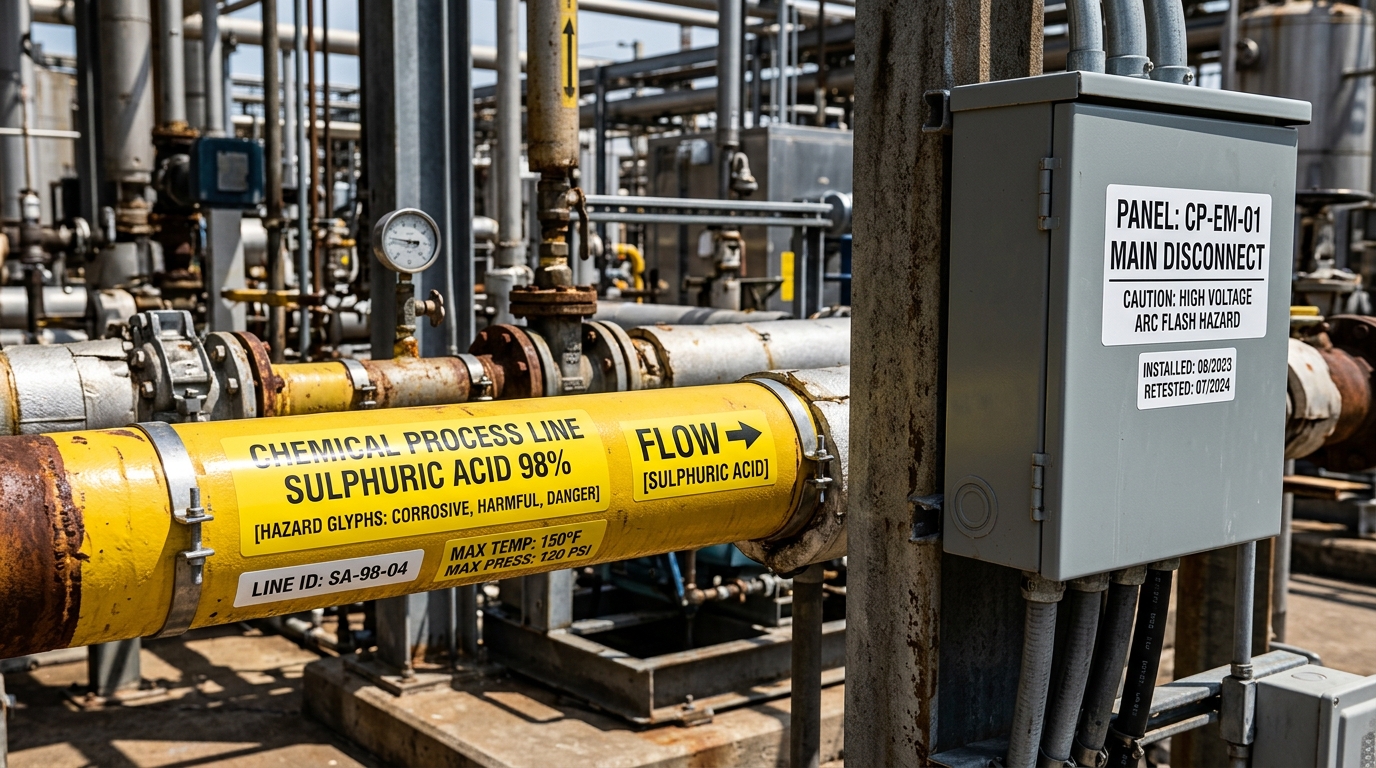
Installed in real-world industrial environment Inspect Standard Industrial Marking Procedure 1 Ensure application surface is dry and free of loose particulate or heavy oil.
2 Peel and apply with steady firm pressure from center to edge.
3 Allow 24 hours for ultimate cross-linked adhesion strength.
Engineering Tolerance: Engineered to withstand standard industrial plant environmental conditions and indoor/outdoor temperature swings.
Substrate Compatibility & Adhesion Matrix Smooth Metals & Stainless Steel
Rigid Thermoplastics & ABS
Tested Environmental Survivability Industrial Plant Temperature Swings Dust, Grease & Mild Fluids Standard Abrasion & Rubbing Long-Term Legend Legibility Recommended Field & Shop Tools:
i3300 / i5100 Benchtop Printer M210 / M610 Handheld Tool Standard Thermal Ribbon
Orderable Part Numbers, Packaging & Distributor SKUs Official Brady SKUs, roll dimensions, package quantities, list pricing, Grainger part numbers, and printer compatibility for B-101 .
Custom orderable roll sizes, continuous tapes, and die-cut parts for B-101 are available through authorized Brady distributors.
Quality Assurance, Storage & Regulatory Compliance Standardized engineering guidelines for warehouse storage, application temperature, and agency certifications.
Shelf Life & Warehouse Storage Expected Shelf Life: 1 Year from receipt
Storage Temperature: Below 80°F (27°C)
Relative Humidity: ≤ 60% RH
Must be stored in original packaging in a climate-controlled warehouse.
Application vs Service Limits Min Application Temp: 50°F (10°C)
Service Temp Range: -40°C to 70°C (-40°F to 158°F)
Full Cure / Dwell Time: 24 Hours (ASTM D1000)Clean surface of oil/grease before bonding for maximum peel strength.
Agency Testing & File Directories Environmental & Safety Standards RoHS 3 Compliance: 2011/65/EU (Pass 2015/863)
REACH Status: SVHC Free (<0.1% w/w)
CA Prop 65: Compliant Notice
Certificates of Conformance (CoC) available on order shipment.
Sponsored Industrial Label Solutions
Industrial Label Printers & Materials
Relevant Technical Equipment & Consumables [Ad Slot spec-mid-B-101]
ASTM Physical & Mechanical Properties Standardized laboratory test data measured in accordance with ASTM D 1000, ASTM D 2979, and ASTM D 2671.
Physical Property Test Method Standard Test Units (US) Metric Units (SI) Total Thickness ASTM D 1000 24 mils (0.0024 in) 0.6 mm
Thermal Transfer Ribbon Compatibility Official Brady recommended ribbons engineered for maximum contrast, smear resistance, and UL certification compliance.
Recommended Thermal Transfer Non-printable hardware, tag, or pre-printed material.
* Note: Testing print permanence with official Brady ribbons is required to maintain UL/CSA agency certification on printed labels.
Chemical & Solvent Resistance Matrix Standardized dip and rub immersion test observations across industrial fuels, oils, solvents, and cleaners.
Tested per ASTM D 895 / Brady standard dip & rub immersion.
Chemical Reagent / Solvent Substrate / Adhesive Effect Thermal Ribbon Permanence 30% Sulfuric Acid NE NE 10% Sulfuric Acid NE NE 50% NaOH NE NE 10% NaOH NE NE Methyl Ethyl Ketone F F Acetone F F 5% Sodium Hypochlorite (bleach) NE NE Methanol F F IPA (Isopropanol) F F ASTM #3 Oil NE NE SAE 20 Oil NE NE Alconox F F Toluene F F Mineral Spirits NE NE Glacial Acetic Acid F F 5% Acetic Acid NE NE Diesel Fuel NE NE Heptane NE NE 10% Sodium Chloride (saline) NE NE 10% Ammonia NE NE Turpentine NE NE Kerosene NE NE Water NE NE Gasoline F F 30% Sulfuric Acid Tested Tested 10% Sulfuric Acid Tested Tested 30% HCI Tested Tested 10% HCI Tested Tested 50% NaOH Tested Tested 10% NaOH Tested Tested Methyl Ethyl Ketone Tested Tested Acetone Tested Tested 5% Sodium Hypochlorite (bleach) Tested Tested Methanol Tested Tested IPA (Isopropanol) Tested Tested ASTM #3 Oil Tested Tested SAE 20 Oil Tested Tested Alconox® Tested Tested Toluene Tested Tested Mineral Spirits Tested Tested Glacial Acetic Acid Tested Tested 5% Acetic Acid Tested Tested Diesel Fuel Tested Tested Heptane Tested Tested 10% Sodium Chloride (saline) Tested Tested 10% Ammonia Tested Tested Turpentine Tested Tested Kerosene Tested Tested Water Tested Tested Gasoline Tested Tested
Environmental & Aging Durability Testing Environmental Exposure Condition Observation & Legibility Result Service temperature -40 to 70 °C
Verified Target Applications & Use Cases Industrial rating plates, asset identification, and electrical component labeling. Brady B-101 Frequently Asked Questions & Engineering Guide Verified technical answers on physical adhesion, temperature thresholds, ribbon pairings, and replacement standards for B-101 .
Expand All Applications & Sizing
What are the primary industrial applications for Brady B-101 (Polycoated Tagstock)? Brady B-101 is a high-performance Polycoated tagstock designed specifically for rating plates, asset tags, and industrial equipment identification. It features a Specialty adhesive engineered for long-term industrial reliability in environments requiring -40°C to 70°C (-40°F to 158°F) performance.
Temperature & Environment
What is the continuous operating temperature range for Brady B-101? Brady B-101 is rated for continuous service temperatures from -40°C to 70°C (-40°F to 158°F). In laboratory heat-aging tests, it maintains dimensional stability and barcode contrast across broad thermal cycles.
Adhesion & Substrates
How well does Brady B-101 adhere to stainless steel, powder coat, and plastic surfaces? Ribbons & Hardware
Which thermal transfer ribbons and Brady printers are compatible with B-101? Chemical Resistance
How does Brady B-101 withstand industrial chemicals, solvents, and fuels? Standards & Compliance
Is Brady B-101 UL Recognized, CSA Accepted, or Halogen-Free? Limitations & Troubleshooting
What surface preparation is required before installing Brady B-101? Need Custom Engineering Validation for Brady B-101? Calculate conductor sizing, check chemical resistance charts, or find matching thermal transfer ribbons.