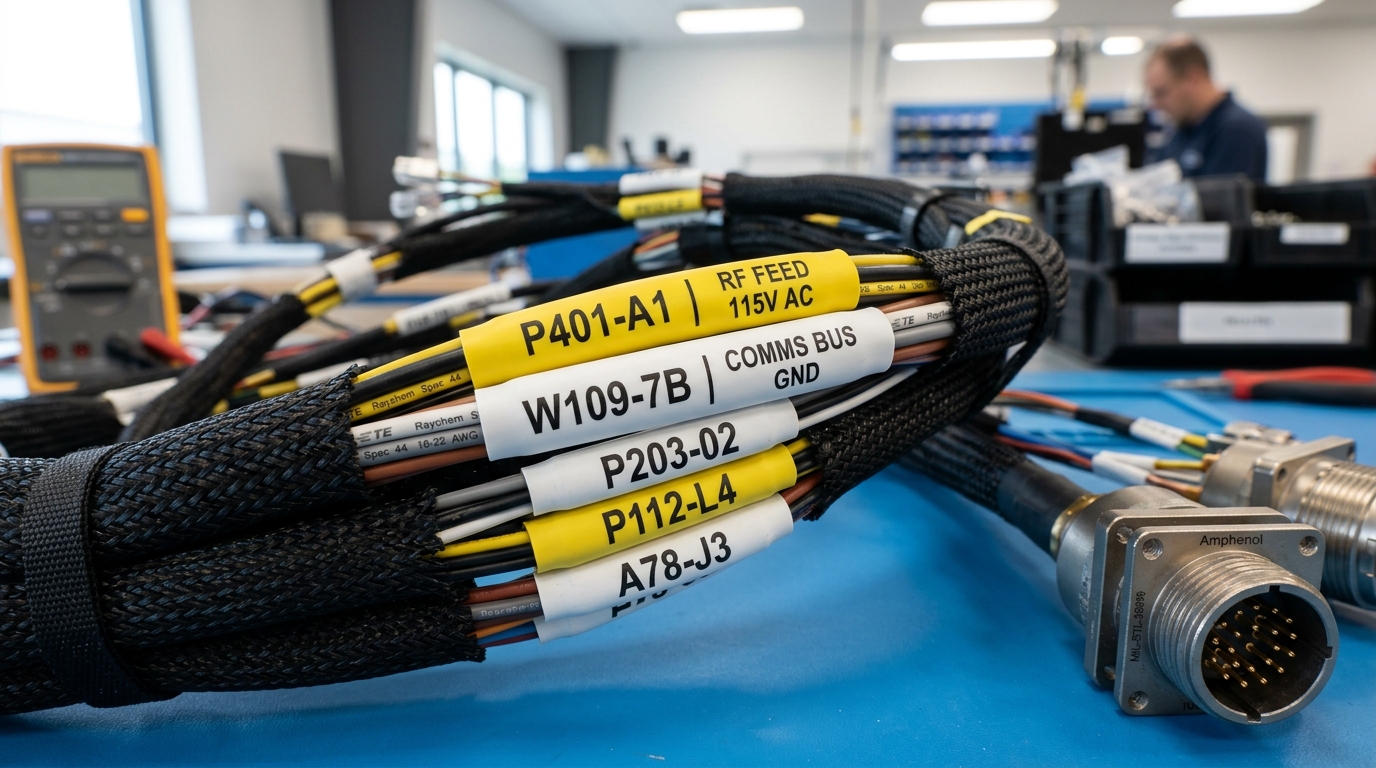
Brady B-321 wire_heat_shrink_sleeve
Brady B-321: BradySleeve Marker BRADYSLEEVE MARKER is a heat shrinkable, high density polyolefin film used to identify electrical wires and cables.
Material Composition Heat shrinkable, high density polyolefin film
Adhesive System Non-Adhesive
Operating Temperature -40°C to 200°C (-40°F to 392°F)
Total Thickness 17 mils (0.432 mm)
B-321 Application & Installation Blueprint PermaSleeve® Heat-Shrink Wire Tubing • Physical application tolerances and surface engineering
Installed in real-world industrial environment Inspect 3:1 Heat-Shrink Sleeve Recovery Procedure 1 Slide the unrecovered tubular sleeve over the wire lead prior to connector crimping.
2 Position sleeve at the desired marker distance from the terminal pin.
3 Apply focused hot air at 250°F (120°C) with an industrial heat gun until polyolefin shrinks snugly around wire.
Engineering Tolerance: 3:1 Shrink Ratio recovers down to 33% of expanded diameter. Meets SAE-AS-81531 and MIL-STD-202.
Substrate Compatibility & Adhesion Matrix Mil-Spec Aircraft Wire (M22759)
Cross-Linked Polyethylene (XLPE)
Kapton & Tefzel Wire Bundles
Tested Environmental Survivability SAE-AS-81531 Mil-Spec Rub MIL-STD-202 Method 215K Aviation Fuel & Diesel High Vibration & Flexing Recommended Field & Shop Tools:
Industrial Heat Gun with Reflector Nozzle i7100 / BBP72 Double-Sided Printer M610 Portable Tool
Orderable Part Numbers, Packaging & Distributor SKUs Official Brady SKUs, roll dimensions, package quantities, list pricing, Grainger part numbers, and printer compatibility for B-321 .
Custom orderable roll sizes, continuous tapes, and die-cut parts for B-321 are available through authorized Brady distributors.
Quality Assurance, Storage & Regulatory Compliance Standardized engineering guidelines for warehouse storage, application temperature, and agency certifications.
Shelf Life & Warehouse Storage Expected Shelf Life: 2 Years from receipt
Storage Temperature: Below 80°F (27°C)
Relative Humidity: ≤ 60% RH
Must be stored in original packaging in a climate-controlled warehouse.
Application vs Service Limits Min Application Temp: 50°F (10°C)
Service Temp Range: -40°C to 200°C (-40°F to 392°F)
Full Cure / Dwell Time: 24 Hours (ASTM D1000)Clean surface of oil/grease before bonding for maximum peel strength.
Agency Testing & File Directories Halogen-Free per DIN VDE 0472 Part 815 Environmental & Safety Standards RoHS 3 Compliance: 2011/65/EU (Pass 2015/863)
REACH Status: SVHC Free (<0.1% w/w)
CA Prop 65: Compliant Notice
Certificates of Conformance (CoC) available on order shipment.
Sponsored Industrial Label Solutions
Industrial Label Printers & Materials
Relevant Technical Equipment & Consumables [Ad Slot spec-mid-B-321]
ASTM Physical & Mechanical Properties Standardized laboratory test data measured in accordance with ASTM D 1000, ASTM D 2979, and ASTM D 2671.
Physical Property Test Method Standard Test Units (US) Metric Units (SI) Total Thickness ASTM D 1000 17 mils (0.0017 in) 0.432 mm
Thermal Transfer Ribbon Compatibility Official Brady recommended ribbons engineered for maximum contrast, smear resistance, and UL certification compliance.
Recommended Thermal Transfer * Note: Testing print permanence with official Brady ribbons is required to maintain UL/CSA agency certification on printed labels.
Chemical & Solvent Resistance Matrix Standardized dip and rub immersion test observations across industrial fuels, oils, solvents, and cleaners.
Tested per ASTM D 895 / Brady standard dip & rub immersion.
Chemical Reagent / Solvent Substrate / Adhesive Effect Thermal Ribbon Permanence Methyl Ethyl Ketone No visible effect No visible effect Toluene No visible effect No visible effect Isopropyl Alcohol Slight print fade Slight print fade JP-8 Jet Fuel Slight print fade Slight print fade Kerosene Slight print fade Slight print fade Mil 5606 Oil Topcoat Slight print fade Slight print fade Mil 7808 Oil Topcoat No visible effect No visible effect Speedi Kut Cutting Oil 332 No visible effect No visible effect Gasoline Slight print fade Slight print fade Rust Veto 377 Topcoat Slight print fade Slight print fade Skydrol 500B-4 Moderate print fade Moderate print fade Super Agitene Slight print fade Slight print fade BIOACT EC-7R Terpene Cleaner Slight print fade Slight print fade Deionized Water No visible effect No visible effect 3% Alconox Detergent No visible effect No visible effect 5% Salt (NaCl) solution No visible effect No visible effect Propylene Glycol No visible effect No visible effect Methyl Ethyl Ketone Tested Tested Toluene Tested Tested Isopropyl Alcohol Tested Tested JP-8 Jet Fuel Tested Tested Mil 5606 Oil Tested Tested Mil 7808 Oil Tested Tested Speedi Kut Cutting Oil 332 Tested Tested Rust Veto® 377 Tested Tested Skydrol® 500B-4 Tested Tested Super Agitene® Tested Tested BIOACT® EC-7R™ Terpene Cleaner Tested Tested Deionized Water Tested Tested 3% Alconox® Detergent Tested Tested 5% Salt (NaCl) solution Tested Tested Propylene Glycol Tested Tested
Environmental & Aging Durability Testing Environmental Exposure Condition Observation & Legibility Result Service temperature -40 to 200 °C
Verified Target Applications & Use Cases Industrial rating plates, asset identification, and electrical component labeling. Brady B-321 Frequently Asked Questions & Engineering Guide Verified technical answers on physical adhesion, temperature thresholds, ribbon pairings, and replacement standards for B-321 .
Expand All Applications & Sizing
What are the primary industrial applications for Brady B-321 (BradySleeve Marker)? Brady B-321 is a high-performance Heat shrinkable, high density polyolefin film designed specifically for rating plates, asset tags, and industrial equipment identification. It features a Specialty adhesive engineered for long-term industrial reliability in environments requiring -40°C to 200°C (-40°F to 392°F) performance.
Temperature & Environment
What is the continuous operating temperature range for Brady B-321? Brady B-321 is rated for continuous service temperatures from -40°C to 200°C (-40°F to 392°F). In laboratory heat-aging tests, it maintains dimensional stability and barcode contrast across broad thermal cycles.
Adhesion & Substrates
How well does Brady B-321 adhere to stainless steel, powder coat, and plastic surfaces? Ribbons & Hardware
Which thermal transfer ribbons and Brady printers are compatible with B-321? Chemical Resistance
How does Brady B-321 withstand industrial chemicals, solvents, and fuels? Standards & Compliance
Is Brady B-321 UL Recognized, CSA Accepted, or Halogen-Free? Limitations & Troubleshooting
What surface preparation is required before installing Brady B-321? Need Custom Engineering Validation for Brady B-321? Calculate conductor sizing, check chemical resistance charts, or find matching thermal transfer ribbons.