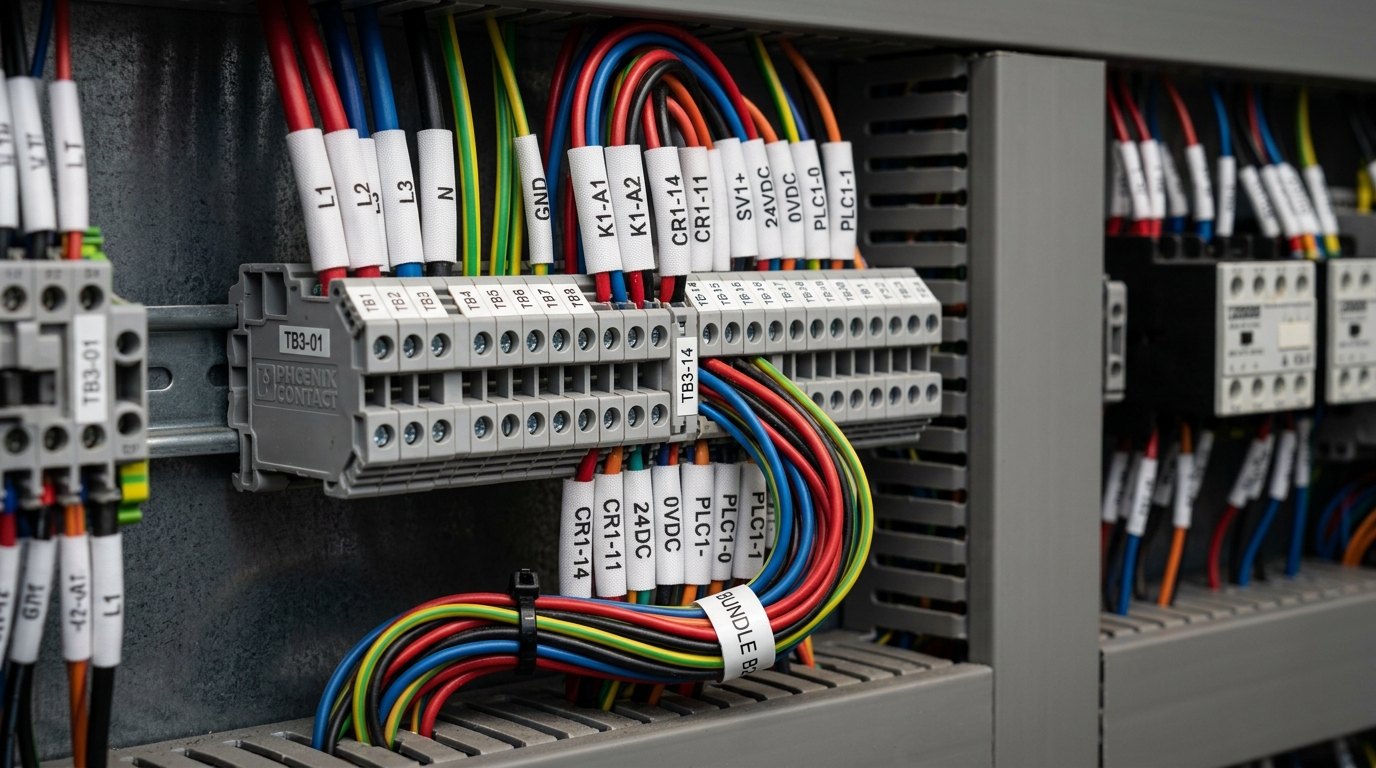
The terminal block lockout is made of non-conductive ABS material with a temperature range of -20°C to 120°C and includes chemical resistance to various substances.
Material Composition
ABS
Adhesive System
Non-Adhesive
Operating Temperature
-20°C to 120°C (-4°F to 248°F)
Total Thickness
—
Flexible Nylon Cloth
LOTO-92 Application & Installation Blueprint
Repositionable Nylon Cloth & DIN Rail Label • Physical application tolerances and surface engineering
Industrial Fit Certified
Installed in real-world industrial environment
Conformable Cloth Wire & Terminal Marking
1Wrap tightly around wire leads or press firmly across DIN terminal block rows.
2Flexible woven cloth matrix conforms seamlessly to irregular cable curves with zero flagging.
3Can be cleanly removed and repositioned during cabinet wiring changes without leaving sticky residue.
Engineering Tolerance: High-conformability woven polyamide coating grips tight wire curves without flagging or memory spring-back.
Substrate Compatibility & Adhesion Matrix
Terminal Block Rows (Phoenix/WAGO)
High Grip (5/5)
Multi-Conductor Cable Bundles
No Flagging (5/5)
DIN Rail Relay Sockets
Clean Removal (4.8/5)
Patch Panel Wire Flags
High Conform (5/5)
Tested Environmental Survivability
High Flexibility & No FlaggingClean RemovabilityMild Solvents & OilCabinet Temperatures (-40°F to 194°F)
Standardized laboratory test data measured in accordance with ASTM D 1000, ASTM D 2979, and ASTM D 2671.
Physical Property
Test Method
Standard Test Units (US)
Metric Units (SI)
Thermal Transfer Ribbon Compatibility
Official Brady recommended ribbons engineered for maximum contrast, smear resistance, and UL certification compliance.
Recommended Thermal Transfer
Non-printable hardware, tag, or pre-printed material.
* Note: Testing print permanence with official Brady ribbons is required to maintain UL/CSA agency certification on printed labels.
Chemical & Solvent Resistance Matrix
Standardized dip and rub immersion test observations across industrial fuels, oils, solvents, and cleaners.
Tested per ASTM D 895 / Brady standard dip & rub immersion.
Chemical Reagent / Solvent
Substrate / Adhesive Effect
Thermal Ribbon Permanence
Acetone
Tested
Tested
Petroleum
Tested
Tested
Turpentine oil
Tested
Tested
Chlorine, chlorine water
Tested
Tested
Turpentine substitute (white spirit)
Tested
Tested
Fuel, engine
Gasoline (normal & premium grade)
Gasoline (normal & premium grade)
Trichloroethane 1,1,1
Tested
Tested
Lubrication oil
gear oil
gear oil
Lubricating oil
HD engine oils, hydraulic oils, transformer oils
HD engine oils, hydraulic oils, transformer oils
Fuel, engine
M15 mixture (15% methanol)
M15 mixture (15% methanol)
Water (including seawater)
Tested
Tested
Methanol
Tested
Tested
Hydraulic oils
Tested
Tested
Transformer oils
Tested
Tested
Environmental & Aging Durability Testing
Environmental Exposure Condition
Observation & Legibility Result
conductive ABS material with a temperature range of -20°C to 120°C and includes chemical resistance to various substances.
## Verified specifications
- Material type
ABS
Service temperature
-20 to 120 °C
Verified Target Applications & Use Cases
Industrial rating plates, asset identification, and electrical component labeling.
Verified technical answers on physical adhesion, temperature thresholds, ribbon pairings, and replacement standards for LOTO-92.
Brady LOTO-92 is a high-performance ABS designed specifically for rating plates, asset tags, and industrial equipment identification. It features a Specialty adhesive engineered for long-term industrial reliability in environments requiring -20°C to 120°C (-4°F to 248°F) performance.
Brady LOTO-92 is rated for continuous service temperatures from -20°C to 120°C (-4°F to 248°F). In laboratory heat-aging tests, it maintains dimensional stability and barcode contrast across broad thermal cycles.
Need Custom Engineering Validation for Brady LOTO-92?
Calculate conductor sizing, check chemical resistance charts, or find matching thermal transfer ribbons.