Brady B-423 vs. B-483A Comparison
Smooth Metal High-Clarity Rating Plate vs. Ultra-High-Tack Textured Powder-Coat & Low Surface Energy (LSE) Adhesion. This in-depth technical analysis provides side-by-side engineering data, ASTM laboratory adhesion scores, operating temperature thresholds, chemical immersion resistance, and Total Cost of Ownership (TCO) models.
Choose B-423 for smooth stainless steel, flat bare aluminum, PCB component tracking, and cleanroom instrumentation (>45 dynes/cm surface energy) where standard permanent acrylic adhesive delivers high barcode contrast and cost efficiency. Choose B-483A for textured powder-coated steel enclosures, cast iron housings, and low surface energy (LSE) plastics (Polypropylene, HDPE at 28–32 dynes/cm) where its 2.0-mil heavy rubber adhesive wet-flows into micro-roughness valleys to deliver 104–160 oz/in peel adhesion and eliminate field label popping.
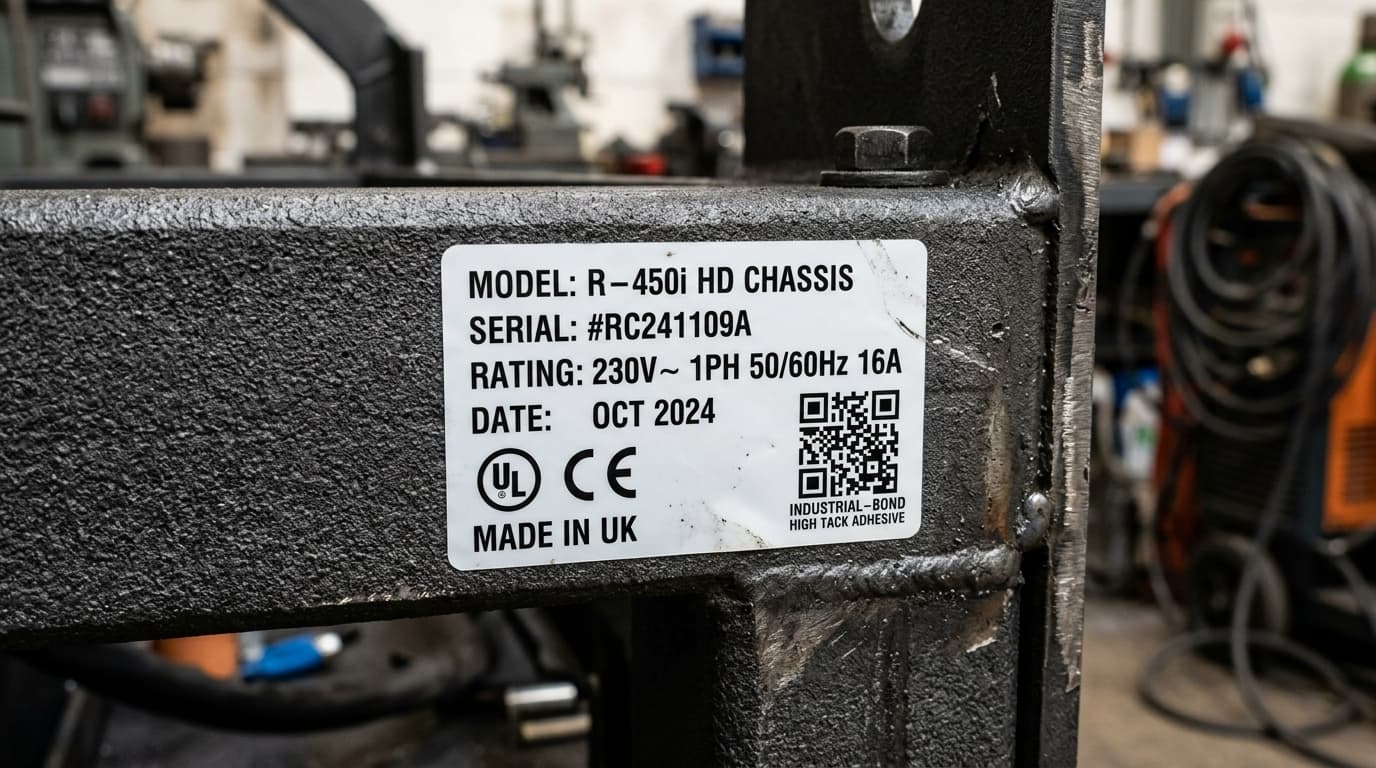
1. Surface Energy, Contact Angle & Micro-Roughness Valley Wetting Physics
The fundamental physical constraint governing industrial rating plate permanence is the thermodynamic wetting relationship between the adhesive's liquid surface tension and the substrate's solid surface energy (measured in dynes/cm), combined with the adhesive's viscoelastic flow into micro-roughness valleys.
B-423: Permanent Acrylic on High Surface Energy (HSE) Substrates
B-483A: Ultra-Aggressive Rubber on Low Surface Energy (LSE) & Powder Coatings
2. Substrate Peel Adhesion Matrix (ASTM D1000 180° Peel)
Standardized 180° peel adhesion testing across high surface energy (HSE), low surface energy (LSE), and textured powder-coated substrates after 20-minute and 24-hour dwell periods.
| Test Substrate | Surface Energy | B-423 Peel Force | B-483A Peel Force | Outcome |
|---|---|---|---|---|
| Stainless Steel (Smooth / Passivated) | ~700–1000 bare / >45 passivated | 20-min: 51 oz/in (56 N/100mm) 24-hr: 57 oz/in (62 N/100mm) | 20-min: 155 oz/in (169 N/100mm) 24-hr: 160 oz/in (174 N/100mm) | B-483A (+180% higher ultimate peel force) |
| Polyester Powder Coated Paint (Textured) | 28–36 dynes/cm (LSE + Texture) | 20-min: 32 oz/in (35 N/100mm) 24-hr: 43 oz/in (47 N/100mm) | 20-min: 102 oz/in (111 N/100mm) 24-hr: 104 oz/in (113 N/100mm) | B-483A (2.4x to 3.2x higher adhesion; zero tenting) |
| Polypropylene (LSE Molded Plastic) | 29–31 dynes/cm (Low Surface Energy) | 20-min: 36 oz/in (40 N/100mm) 24-hr: 39 oz/in (42 N/100mm) | 20-min: 140 oz/in (153 N/100mm) 24-hr: 143 oz/in (156 N/100mm) | B-483A (3.7x higher peel; overcomes olefin barrier) |
| Textured ABS Plastic (Pebble Finish) | 38–42 dynes/cm (Molded Texture) | 20-min: 10 oz/in (10 N/100mm) 24-hr: 10 oz/in (10 N/100mm) | 20-min: 55 oz/in (60 N/100mm) 24-hr: 54 oz/in (59 N/100mm) | B-483A (5.4x higher peel; fills textured pores) |
| Painted Enamel (Smooth Gloss Industrial) | 40–45 dynes/cm (Medium Energy) | 20-min: 51 oz/in (56 N/100mm) 24-hr: 54 oz/in (59 N/100mm) | 20-min: 144 oz/in (157 N/100mm) 24-hr: 149 oz/in (162 N/100mm) | B-483A (2.8x higher ultimate grip) |
| ASTM D2979 Quick Probe Tack | Instant Initial Grab Test | 20-min: 26 oz (800 grams) 24-hr: 26 oz (800 grams) | 20-min: 39 oz (1,122 grams) 24-hr: 39 oz (1,122 grams) | B-483A (+40% higher instant aggressive tack) |
3. Total Cost of Ownership (TCO) & Labor Economics: Smooth Metal vs. Powder-Coat Risk Model
Saving $0.05 on a label unit price creates massive corporate financial liability if serial rating plates delaminate from powder-coated enclosures in the field, triggering RMA returns, warranty service calls, and factory audit stoppages.
| Economic Dimension | B-423 Standard Polyester (Smooth Metals) | B-483A Ultra-Aggressive Polyester (Powder Coat & LSE) |
|---|---|---|
| Average Material Unit Price (2.0" x 1.0" Decal)B-483A carries ~$0.05/label premium for double rubber adhesive coat weight. | $0.09 / label | $0.14 / label |
| Application Labor Cost (@ $60/hr, 12s dwell)Identical manual application labor on clean production line. | $0.20 (12 sec peel & apply) | $0.20 (12 sec peel & apply) |
| Total Initial Installed Cost Per UnitInitial cost difference is negligible ($50 per 1,000 units). | $0.29 / unit | $0.34 / unit |
| Adhesion Failure Probability on Powder-Coat (18 Mo)B-423's 1.0 mil acrylic cannot bridge textured powder coat valleys. | 25% – 45% (Tenting, edge-flagging, popping) | < 0.01% (Permanent viscoelastic grip) |
| Field Service Technician Dispatch / RMA Cost Per FailureField labor, travel, serial number re-validation, customer downtime penalty. | $150.00 – $450.00+ / claim | $0.00 (Zero field failures) |
| Effective Risk-Adjusted Cost Per 1,000 Installed UnitsSpecifying B-483A yields a 111x Total Cost of Ownership savings on powder-coat! | $37,790 (250 field failures @ $150) | $340 (Zero warranty failures) |
4. 15-Point Parametric Specification Diff
Direct ASTM laboratory metrics, operating limits, and physical mechanical properties extracted from verified Brady Technical Data Sheets (TDS).
| Technical Dimension | B-423 (Gloss White Permanent Polyester Rating Plates) | B-483A (Ultra-Aggressive High-Tack Polyester for Textured & LSE Surfaces) | Key Advantage |
|---|---|---|---|
| Facestock Polymer Chemistry | 2.0 mil (0.051 mm) Gloss White Polyester Film | 2.0 mil (0.051 mm) Gloss White Polyester Film | Tie (Identical high-clarity polyester facestock) |
| Adhesive Formulation & Chemistry | Permanent Acrylic Adhesive (High Cohesion) | Ultra-Aggressive Permanent Rubber-Based Adhesive (High Tack) | B-423 (Chemical Cohesion) vs B-483A (Extreme LSE Grip) |
| Adhesive Thickness / Coat Weight | 1.0 mil (0.025 mm) Standard Acrylic Coat Weight | 2.0 mil (0.051 mm) Heavy High-Flow Rubber Coat Weight | B-483A (2x thickness fills micro-texture valleys) |
| Total Construction Caliper (Thickness) | 3.0 mil (0.076 mm) Total Thickness (ASTM D1000) | 4.0 mil (0.102 mm) Total Thickness (ASTM D1000) | B-423 (Lower profile) vs B-483A (Heavy duty body) |
| ASTM D2979 Quick Probe Tack | 26 oz (800 grams) Instant Probe Tack | 39 oz (1,122 grams) Instant Probe Tack | B-483A (+40% higher instant grab upon contact) |
| Peel Adhesion on Stainless Steel (24-hr Dwell) | 57 oz/in (62 N/100mm) (ASTM D1000) | 160 oz/in (174 N/100mm) (ASTM D1000) | B-483A (2.8x higher ultimate peel adhesion) |
| Peel Adhesion on Polyester Powder-Coat (24-hr) | 43 oz/in (47 N/100mm) (Prone to edge lifting) | 104 oz/in (113 N/100mm) (Permanent bond) | B-483A (2.4x higher grip; engineered for powder coat) |
| Peel Adhesion on Polypropylene LSE Plastic (24-hr) | 39 oz/in (42 N/100mm) (Low wetting / flags easily) | 143 oz/in (156 N/100mm) (Massive aggressive grip) | B-483A (3.7x higher grip on low surface energy olefin) |
| Peel Adhesion on Textured ABS (24-hr Dwell) | 10 oz/in (10 N/100mm) (Immediate failure risk) | 54 oz/in (59 N/100mm) (Strong functional hold) | B-483A (5.4x higher adhesion on textured pebble finish) |
| Continuous Operating Temperature Range | -70°C to +110°C (-94°F to +230°F) | -40°C to +120°C (-40°F to +248°F) | B-423 (Lower cryogenic -70°C) vs B-483A (+120°C high) |
| Short-Term High Temperature Resistance | Survives 180°C (5 min); shrinks at 200°C–210°C | Survives 120°C (30 days continuous without change) | B-423 (Short-term 180°C peak spike tolerance) |
| UL 969 Marking Recognition (File MH17154) | UL Recognized with R6000HF, R4900, R4400, R6200 ribbons | UL Recognized with R6000HF and R4900 ribbons | B-423 (Broader certified ribbon compatibility matrix) |
| CSA Acceptance (File 041833 / C22.2 No. 0.15) | CSA Accepted with Series R6000 Halogen Free ribbon | CSA Accepted with Series R6000 Halogen Free ribbon | Tie (Both require R6000HF for CSA Canadian compliance) |
| Dielectric Insulation Breakdown Strength | 8,400 Volts/mil (ASTM D1000 / ASTM D2671) | High Dielectric Insulation (Polyester Barrier) | B-423 (Specifically rated at 8,400 V/mil for PCB isolation) |
| Environmental Weatherability (ASTM G155 / B117) | Passed 30 days Xenon Arc & 30 days 5% Salt Fog Chamber | Passed 30 days Xenon Arc & 30 days 5% Salt Fog Chamber | Tie (Both withstand harsh UV, salt fog, and 95% humidity) |
5. Chemical Immersion & Harsh Solvent Head-to-Head
Standardized 5-cycle immersion testing (10-minute fluid exposure + 30-minute recovery period per ASTM protocols followed by cotton swab rub tests).
| Chemical Reagent | B-423 Observation | B-483A Observation | Outcome |
|---|---|---|---|
| Methyl Ethyl Ketone (MEK) | Slight adhesive ooze; print legible w/o rub (Rating 1) | Slight adhesive ooze; print legible w/o rub, removed on rub | B-423 |
| Acetone | Slight adhesive ooze; print unaffected w/o rub | Adhesive swelling; complete print removal on rub | B-423 |
| Isopropyl Alcohol (IPA 99%) | Passed (No visible effect on substrate, adhesive, or print) | Passed (No visible effect on substrate, adhesive, or print) | Tie |
| Gasoline (Automotive Unleaded) | Slight adhesive ooze; print 100% intact with R6000HF | Passed (No visible effect on adhesive; print intact) | Tie |
| JP-8 Aviation Jet Fuel | Slight adhesive ooze; print 100% intact with R6000HF | Passed (No visible effect on adhesive; print intact) | B-483A |
| Brake Fluid (DOT 3 / DOT 4) | Adhesive softening; print intact with R6000HF | Moderate adhesive softening; print legible | Tie |
| Skydrol® 500B-4 Hydraulic Fluid | Adhesive edge dissolution; severe rub removal | No visible effect on adhesive; severe print removal on rub | B-483A |
| SAE 20 WT Engine Oil & MIL-H-5606 | Passed (No visible effect on substrate or R6000HF print) | Passed (No visible effect on substrate or R6000HF print) | Tie |
| Mineral Spirits & Aliphatic Solvents | Passed (No visible effect on adhesive or print) | Slight adhesive ooze; print 100% intact | B-423 |
| 3% Alconox® Industrial Detergent | Passed (No visible effect after 30-day immersion) | Passed (No visible effect after 30-day immersion) | Tie |
| Northwoods Buzz Saw Citrus Degreaser | Passed (No visible effect on label or print) | Passed (No visible effect on label or print) | Tie |
| Deionized Water & Salt Fog (ASTM B117) | Passed (30 days 5% salt fog chamber: zero degradation) | Passed (30 days 5% salt fog chamber: zero degradation) | Tie |
6. Failure Modes: When to NEVER Use B-423 vs. B-483A
Critical engineering boundary limits where material physics fail under extreme environmental, mechanical, or chemical stress.
- Textured Powder-Coated Metal Enclosures: Adhesion drops to 32–43 oz/in (and <10 oz/in on heavily textured ripple/sandstone powder paints). Microscopic bridging over paint texture valleys results in air voids, edge flagging, and eventual label popping under thermal cycling.
- Low Surface Energy (LSE) Plastics: Untreated Polypropylene (PP, 29 dynes/cm), High-Density Polyethylene (HDPE, 31 dynes/cm), and pebbled ABS molded cases where standard acrylic cannot spontaneously wet out.
- Cast Iron & Rough Sand-Cast Metal: Coarse cast surface asperities prevent adequate contact area for thin 1.0 mil acrylic adhesive.
- Cold-Temperature Application (< 50°F / 10°C): Acrylic adhesive undergoes glass transition and loses tack during application below 10°C unless preheated.
- Direct Submersion in Strong Ketones & Aromatic Solvents: Continuous soaking in MEK, Acetone, or Toluene will swell rubber-based adhesive polymers over time (use B-423 or B-489A / B-724 for severe chemical bath resistance).
- Clean Removal / Temporary Labeling Applications: B-483A's 160 oz/in ultra-high tack tears the polyester face upon removal and leaves gummy rubber residue (never use for calibration decals or 5S shelf markers — use B-581 instead).
- Electronic PCB Wave Solder / Reflow (> 260°C): Rubber adhesive will outgas, discolor, and char at wave solder temperatures (use polyimide B-652 or B-724).
- Smooth Flat Stainless Steel When B-423 Meets All Specs: Unnecessary $0.05/label cost premium when the surface is 100% smooth passivated stainless steel or flat glass.
7. Hardware Intelligence: Thermal Transfer Ribbon Formulation & Printers
A high-performance rating plate or wire marker is only as durable as the thermal transfer ribbon chemistry paired with it.
Engineering Decision FAQ: B-423 vs. B-483A
Powder-coated paint finishes create two major physical obstacles for standard adhesives: low surface energy (typically 28–36 dynes/cm) and microscopic surface roughness ('orange peel' or sandstone texture). B-423 features a thin 1.0 mil acrylic adhesive engineered for high surface energy (>45 dynes/cm) smooth metals. When placed on textured powder coat, B-423's adhesive only bridges the peaks (asperities) of the texture, contacting less than 25% of the surface area. Over time, thermal expansion, vibration, and low initial tack cause the label edges to lift ('flag') and pop off completely. B-483A solves this with a 2.0 mil heavy rubber adhesive that wet-flows into the texture valleys to achieve 104 oz/in peel adhesion.
Yes! Polypropylene (PP: ~29 dynes/cm) and High-Density Polyethylene (HDPE: ~31 dynes/cm) are notoriously difficult for industrial adhesives to stick to because non-polar polymer chains resist adhesive wetting. In standardized ASTM D1000 testing, B-483A achieves an astonishing 143 oz/in (156 N/100mm) peel adhesion on polypropylene—more than 3.7x the bond strength of B-423 (39 oz/in). This makes B-483A the premier choice for molded plastic power tool housings, automotive fluid reservoirs, chemical storage drums, and battery casings.
B-483A is the modern updated technical designation for Brady's ultra-aggressive glossy white polyester material family (superseding the older B-483 designation). Both share the same physical construction: a 2.0 mil gloss white polyester facestock coated with a 2.0 mil high-tack rubber-based adhesive (total 4.0 mil caliper). Cartridges and rolls marked B-483 or B-483A are fully interchangeable and meet the same UL 969 and CSA specifications.
For both B-423 and B-483A, you must print with Brady Series R6000 Halogen Free (R6000HF) pure resin ribbon or Series R4900 resin ribbon to maintain UL 969 Recognition under File MH17154. For Canadian CSA Acceptance (File 041833), both materials strictly mandate the Series R6000 Halogen Free ribbon. Printing with uncertified wax or generic wax/resin ribbons will void UL/CSA compliance and result in print rub-off under solvent exposure.
Adhesion is a function of actual surface contact area. Standard rating plate labels like B-423 use a 1.0 mil (0.025 mm) adhesive coat weight, which is ideal for flat, polished stainless steel. However, cast iron, sand-cast aluminum, and textured powder coatings have surface peak-to-valley depths exceeding 1.0 to 1.5 mils. B-483A provides a 2.0 mil (0.051 mm) adhesive layer—double the standard thickness. Under finger or burnish pressure, this heavy viscoelastic adhesive flows into the microscopic valleys, creating complete surface wetting and mechanical interlocking.
Yes. Both B-423 and B-483A undergo rigorous 30-day Xenon Arc Weatherometer exposure (ASTM G155 Cycle 1) and 30-day 5% Salt Fog Chamber testing (ASTM B117) with zero visible degradation. B-483A's polyester facestock provides excellent UV and dimensional stability. However, if extreme ketone or aromatic solvent immersion is expected outdoors, specify B-489A (ultra-high tack acrylic adhesive) as an alternative.
No. B-483A is an ultra-aggressive permanent adhesive engineered specifically to prevent unauthorized tampering, peeling, or accidental detachment. With a 24-hour peel strength of 160 oz/in on stainless steel, attempting to remove B-483A will tear or delaminate the polyester facestock and leave a heavy rubber adhesive residue on the substrate. If clean, residue-free removability is required for calibration or 5S lean markers, choose B-581 (repositionable vinyl) or B-498 (repositionable vinyl cloth).