Brady B-427 vs. B-499A Comparison
Clear Overlaminate Fluid Barrier vs. Zero-Memory Pliable Fabric for Terminal Blocks & Tight Flags. This in-depth technical analysis provides side-by-side engineering data, ASTM laboratory adhesion scores, operating temperature thresholds, chemical immersion resistance, and Total Cost of Ownership (TCO) models.
Choose B-427 when marking round cables exposed to moisture, oils, hydraulic fluid splash, or high-abrasion pulling, where its clear vinyl tail encapsulates and protects the printed text. Choose B-499A for terminal blocks (Phoenix Contact, WAGO, Allen-Bradley), patch panels, tight-radius wire flags (28–24 AWG), motor leads, and high-temperature cabinets (-40°C to 90°C continuous, 145°C intermittent) where zero-memory nylon cloth eliminates edge-flagging.
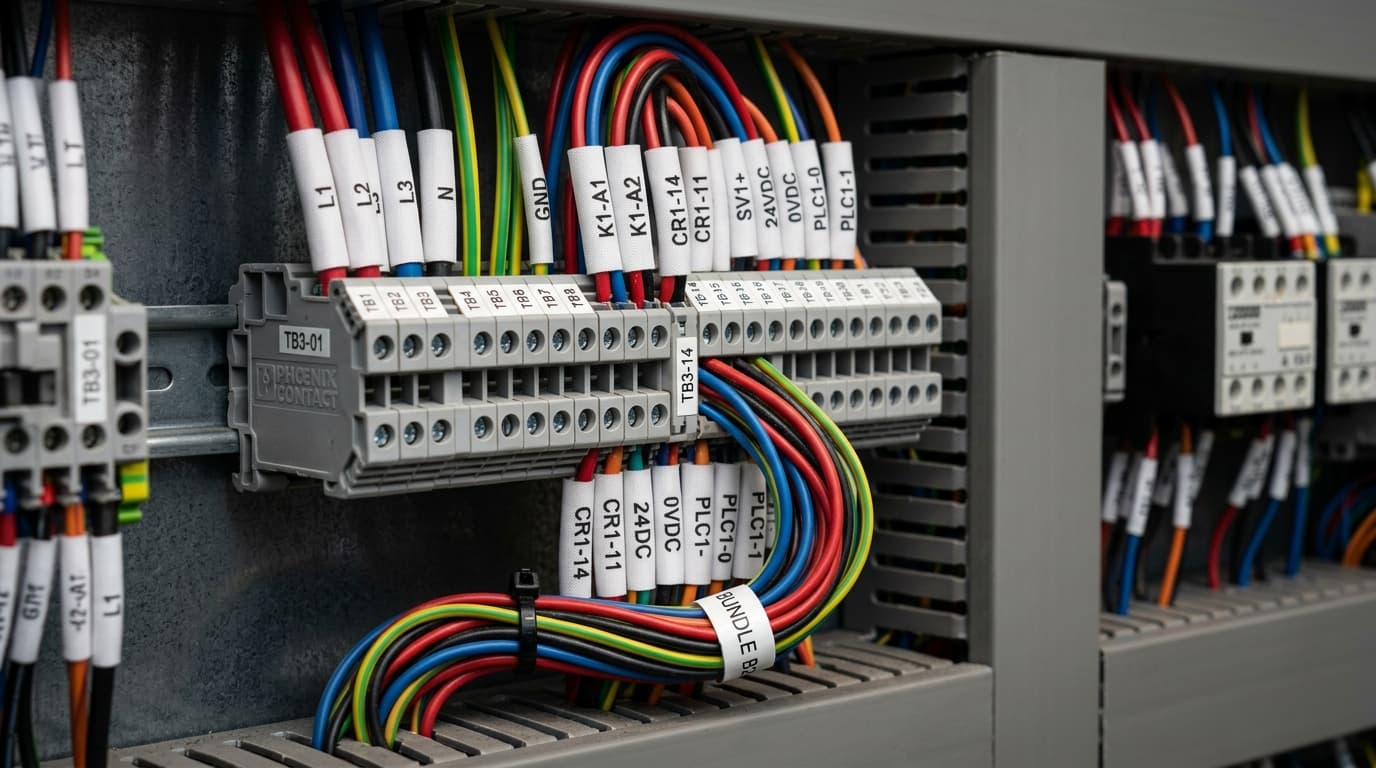
1. Mechanical Conformability, Elastic Bending Memory & Micro-Curvature Physics
The fundamental physical difference governing wire wrap performance is the mechanical bending modulus and elastic memory of the facestock polymer. When applied around small diameters or tight angles, rigid films generate continuous restorative spring-back forces.
B-427: Translucent Vinyl with Overlaminating Tail Mechanism
B-499A: Woven Polyamide Nylon Cloth with Zero-Memory Bending
2. Substrate Peel Adhesion Matrix (ASTM D1000 180° Peel)
Standardized 180° peel adhesion testing across high surface energy (HSE), low surface energy (LSE), and textured powder-coated substrates after 20-minute and 24-hour dwell periods.
| Test Substrate | Surface Energy | B-427 Peel Force | B-499A Peel Force | Outcome |
|---|---|---|---|---|
| Stainless Steel (Smooth Plate) | >45 dynes/cm (High Energy) | 20-min: 38 oz/in (42 N/100mm) 24-hr: 45 oz/in (49 N/100mm) | 20-min: 45 oz/in (50 N/100mm) 24-hr: 80 oz/in (88 N/100mm) | B-499A (+78% higher 24-hr bond strength) |
| Textured ABS Plastic (Terminal Blocks) | 38–42 dynes/cm (Pebble Texture) | 20-min: 10 oz/in (10 N/100mm) 24-hr: 10 oz/in (10 N/100mm) | 20-min: 35 oz/in (39 N/100mm) 24-hr: 40 oz/in (44 N/100mm) | B-499A (4.0x higher adhesion; zero cavity lifting) |
| Polypropylene Cable Jackets (LSE) | 29–31 dynes/cm (Low Energy) | 20-min: 15 oz/in (Requires tail overlap) 24-hr: 18 oz/in (Requires tail overlap) | 20-min: 24 oz/in (26 N/100mm) 24-hr: 24 oz/in (26 N/100mm) | B-499A (+33% higher direct jacket peel) |
| Tensile Strength (Machine Direction) | Mechanical Tear Resistance | 20-min: 12 lbs/in (210 N/100mm) 24-hr: 152% Elongation at break | 20-min: 80 lbs/in (1,400 N/100mm) 24-hr: 50% Elongation at break | B-499A (6.6x higher tensile rupture strength) |
| ASTM D2979 Quick Probe Tack | Initial Instant Grab | 20-min: 20 oz (560 grams) 24-hr: 20 oz (560 grams) | 20-min: 29 oz (900 grams) 24-hr: 29 oz (900 grams) | B-499A (+45% higher instant initial grab) |
3. Total Cost of Ownership (TCO) & Labor Economics: Cable Wraps vs. Terminal Blocks & Flags
Material purchase price is trivial compared to labor dwell time and the cost of rewiring or re-labeling electrical panels when wire markers flag or detach inside crowded control cabinets.
| Economic Dimension | B-427 Self-Laminating Vinyl | B-499A Conformable Nylon Cloth |
|---|---|---|
| Average Material Unit PriceB-499A continuous terminal strips reduce material waste. | $0.14 / label (1.0" x 1.5") | $0.10 / label (or $0.06/pole strip) |
| 50-Pole Terminal Block Installation Labor (@ $60/hr)B-499A saves $11.75 in technician labor on every 50-pole terminal array! | $12.50 (50 individual wraps @ 15s each) | $0.75 (1 continuous serialized strip in 45s) |
| Flagging Risk on Small Diameter Wires (<24 AWG)B-427 requires circular tail wrap; B-499A excels as a P/T flag. | 20% – 35% (Elastic memory forces edges open) | < 0.01% (Zero-memory fabric bonds permanently) |
| Fluid Immersion / Washdown DurabilityB-427 is mandatory for wet, oily, or outdoor washdown environments. | 100% Protected (Clear tail seals print zone) | Unwraps in solvents (Porous fabric wicks fluid) |
| High-Volume Automation CapabilityWraptor A6500 eliminates 70%+ labor in wire harness manufacturing. | Brady Wraptor™ A6500 (5.0s print & apply) | Manual application only (Fabric too pliable) |
4. 15-Point Parametric Specification Diff
Direct ASTM laboratory metrics, operating limits, and physical mechanical properties extracted from verified Brady Technical Data Sheets (TDS).
| Technical Dimension | B-427 (Self-Laminating Vinyl Wire & Cable Wraps) | B-499A (Conformable Nylon Cloth Wire & Terminal Markers) | Key Advantage |
|---|---|---|---|
| Base Substrate Chemistry | 4.0 mil (0.102 mm) Translucent Calendered Vinyl Film | 4.5 mil (0.114 mm) Polyamide-Coated Woven Nylon Cloth | B-427 (Clear Overlaminate) vs B-499A (Zero-Memory Cloth) |
| Adhesive Formulation & Caliper | Permanent Acrylic Adhesive (Moderate Tack) | High-Tack Permanent Acrylic Adhesive (2.0 mil coat weight) | B-499A (Higher tack & aggressive grip on textured plastic) |
| Total Construction Thickness | 4.0 mil (0.102 mm) (ASTM D1000) | 6.5 mil (0.165 mm) (ASTM D1000) | B-427 (Low profile wrap) vs B-499A (Heavy duty body) |
| Continuous Service Temperature | -70°C to +70°C (-94°F to +158°F) | -40°C to +90°C (-40°F to +194°F) | B-499A (+20°C higher continuous heat tolerance) |
| Short-Term High Temperature Limit | Discolors & softens at 100°C (212°F) | Survives 145°C (293°F) for 5 min; functional at 180°C | B-499A (High-heat motor leads & equipment enclosures) |
| Mechanical Bending Memory | Moderate elastic spring-back (Requires full 360° overlap) | Zero elastic memory (Pliable woven fibers never flag) | B-499A (Superior for tight wire flags & 90° bends) |
| Peel Adhesion on Stainless Steel (24-hr) | 45 oz/in (49 N/100mm) (ASTM D1000) | 80 oz/in (88 N/100mm) (ASTM D1000) | B-499A (+78% higher bond strength on metal) |
| Peel Adhesion on Textured ABS (24-hr) | 10 oz/in (10 N/100mm) (Prone to lifting) | 40 oz/in (44 N/100mm) (Permanent bond) | B-499A (4.0x higher grip on textured terminal blocks) |
| Tensile Rupture Strength (ASTM D1000) | 12 lbs/in (210 N/100mm) (Machine Dir) | 80 lbs/in (1,400 N/100mm) (Machine Dir) | B-499A (6.6x higher mechanical tear resistance) |
| Print Protection Mechanism | Clear vinyl tail wraps 360° over text (Hermetic shield) | Direct thermal transfer resin/wax dye infusion into cloth | B-427 (Total physical fluid & abrasion encapsulation) |
| UL 969 Marking Recognition | UL Recognized (File MH17154) with R4300 / R7950 | UL Recognized (File MH17154) with R4300 / R4900 / R6000HF | Tie (Both UL 969 Recognized with certified ribbons) |
| CSA Acceptance (C22.2 No. 0.15) | CSA Accepted (File 041833) | CSA Accepted (File 041833) with Series R4300 ribbon | Tie (Both CSA Accepted under File 041833) |
| Environmental Weatherability (ASTM G155) | Good outdoor durability; UV-resistant vinyl | Indoor Only (Nylon cloth wrinkles & embrittles in UV) | B-427 (All-weather & moisture resistance) |
| Terminal Block Strip Profiling | Not recommended (Lifts from textured plastic channels) | Direct continuous strips with printer auto-serialization | B-499A (Official material for DIN rail terminal blocks) |
| Automated Machine Application | Supported on Brady Wraptor™ A6500 (5.0s cycle) | Manual application only | B-427 (Massive labor savings for harness assembly) |
5. Chemical Immersion & Harsh Solvent Head-to-Head
Standardized 5-cycle immersion testing (10-minute fluid exposure + 30-minute recovery period per ASTM protocols followed by cotton swab rub tests).
| Chemical Reagent | B-427 Observation | B-499A Observation | Outcome |
|---|---|---|---|
| Methyl Ethyl Ketone (MEK) | Not Recommended (Dissolves exposed vinyl edges) | Complete unwrap (Solvent dissolves fabric adhesive bond) | B-427 |
| Isopropyl Alcohol (IPA 99%) | Passed (Print encapsulated by clear overlaminate tail) | Complete unwrap on immersion (Fabric wicks fluid) | B-427 |
| Mineral Spirits & Aliphatics | Passed (Protected by clear vinyl tail) | Complete unwrap on immersion | B-427 |
| Gasoline & Automotive Fuel | Passed (Temporary splash tolerated under laminate) | Adhesive failure & label discoloration | B-427 |
| SAE 20 WT Oil at 70°C | Passed (No visible effect on text or laminate) | No unwrap; cloth stained tan; print legible | B-427 |
| MIL-H-5606 Aviation Hydraulic Oil | Passed (Slight edge softening, print 100% intact) | Slight unwrap; cloth stained red; print legible | B-427 |
| 10% Sulfuric Acid Solution | Passed (Zero degradation) | Passed (No visible effect; zero unwrap) | Tie |
| 10% Sodium Hydroxide Solution | Passed (Zero degradation) | Complete unwrap (Caustic dissolves adhesive) | B-427 |
| 3% Alconox® Detergent | Passed (No visible effect) | Passed (No unwrap; print intact) | Tie |
| Northwoods Buzz Saw Citrus Degreaser | Passed (Protected by laminate tail) | Complete unwrap on immersion | B-427 |
| Deionized Water & Moisture Splash | Passed (1000 hrs no effect) | Passed (Zero unwrap in water) | Tie |
| Salt Fog Chamber (ASTM B117) | Passed (30 days 5% salt fog: zero effect) | Passed (30 days 5% salt fog: print legible) | B-427 |
6. Failure Modes: When to NEVER Use B-427 vs. B-499A
Critical engineering boundary limits where material physics fail under extreme environmental, mechanical, or chemical stress.
- DIN Rail Terminal Blocks & Textured Modular Strips: B-427's thin acrylic adhesive cannot establish grip on textured ABS/polycarbonate plastic channels, and calendered vinyl will lift from the recessed edges.
- Tight-Radius Wire Flags on Small-Gauge Wires (<24 AWG): When folded as a P-style or T-style flag without full circular overlap, vinyl elastic memory causes the flag wings to curl open.
- High-Temperature Control Cabinets (>70°C / 158°F): Vinyl softens, shrinks, and discolors in high-heat industrial enclosures and motor housings.
- Silicone or Braided Sleeving Motor Leads: The smooth vinyl face and moderate tack adhesive cannot grip textured, flexible braided wire jackets.
- Direct Fluid Immersion & Harsh Chemical Washdown: Porous woven nylon wicks solvents, ketones, alcohols, and degreasers, causing the adhesive to dissolve and the label to unwrap completely.
- Outdoor & UV Weathering Applications: ASTM G155 testing reveals that outdoor UV exposure causes nylon cloth to wrinkle, yellow, and embrittle within 30 days (Indoor Only).
- Automated Cable Identification Applicators: The flexible, pliable fabric cloth cannot be fed through automated high-speed wire wrapping machines like the Brady Wraptor™ A6500.
- High-Abrasion Conduit Cable Pulls: Woven cloth surface can snag or abrade during tight conduit pulls without a protective clear overlaminate.
7. Hardware Intelligence: Thermal Transfer Ribbon Formulation & Printers
A high-performance rating plate or wire marker is only as durable as the thermal transfer ribbon chemistry paired with it.
Engineering Decision FAQ: B-427 vs. B-499A
Terminal blocks (such as Phoenix Contact, WAGO, or Allen-Bradley terminal strips) are molded from textured engineering plastics (ABS/polycarbonate) and feature narrow, recessed marker channels. B-427 vinyl has polymer memory and moderate initial tack, which causes individual pre-cut labels to lift or curl at the edges. B-499A nylon cloth has zero bending memory and a heavy 2.0 mil high-tack acrylic adhesive (40 oz/in peel on textured ABS vs 10 oz/in for B-427). Furthermore, portable printers like the Brady M210 feature a built-in 'Terminal Block' mode that prints continuous B-499A strips with exact center-to-center pole spacing, reducing marking labor from 12.5 minutes down to 45 seconds per 50-pole block array.
B-427 is mandatory whenever cables are exposed to moisture, water washdown, hydraulic fluids, cutting oils, solvents, or outdoor weathering. B-427 features a clear vinyl tail that wraps 360° over the printed text, creating a hermetic seal against fluids and mechanical abrasion. In contrast, B-499A is a porous woven nylon fabric without an overlaminate. In solvent or liquid immersion tests, fluids wick through the fabric weave and dissolve the adhesive bond, causing complete unwrapping.
When creating a P-style or T-style wire flag, the label is folded in half over the wire so the adhesive halves bond face-to-face. Calendered vinyl (B-427) has natural elastic memory (stiffness) that constantly attempts to flatten out. On thin wires (<24 AWG), the small bend radius creates severe restorative forces that pull the flag wings apart ('flagging'). B-499A is woven from pliable nylon fibers with near-zero bending modulus; when folded over thin conductors, it conforms instantly without any spring-back forces.
B-499A offers superior thermal performance with a continuous operating range of -40°C to +90°C (-40°F to +194°F), and survives short-term exposure up to 145°C (293°F) for 5 minutes (remaining functional up to 180°C). B-427 is rated for -70°C to +70°C (-94°F to +158°F) and softens/discolors at 100°C. For industrial control cabinets with heat-generating VFDs, transformers, or motor leads, B-499A provides essential thermal headroom.
No. B-499A is strictly an indoor-rated material. In standardized ASTM G155 Cycle 1 Xenon Arc Weatherometer testing (simulating outdoor solar radiation and moisture), B-499A wrinkled, yellowed, and embrittled within 30 days. For outdoor wire or terminal marking, use B-427 self-laminating vinyl or B-595 all-weather vinyl.
For both materials, Brady Series R4300 Wax/Resin hybrid ribbon is the primary recommended formulation. Printing B-427 with Series R4300 maintains UL 969 Recognition (File MH17154). For B-499A, Canadian CSA Acceptance (File 041833) strictly mandates the Series R4300 ribbon. B-499A can also be printed with Series R4900 or R6000HF pure resin ribbons for higher chemical resistance.
No. The Brady Wraptor™ A6500 Automated Wire Identification Machine is specifically engineered for self-laminating vinyl materials (B-427). The pliable, limp nature of woven nylon cloth (B-499A) prevents it from being fed, indexed, and wrapped around wires by the Wraptor's high-speed mechanical applicator jaws. B-499A is applied manually from portable cartridges or benchtop rolls.