Brady B-593 vs. B-483A Comparison
3D Embossed Engraved-Look Legend Plates vs. Low-Profile Flat High-Tack Rating Decals. This in-depth technical analysis provides side-by-side engineering data, ASTM laboratory adhesion scores, operating temperature thresholds, chemical immersion resistance, and Total Cost of Ownership (TCO) models.
Choose B-593 for 22.5mm and 30.5mm push-button legend plates, emergency stop rings, external cabinet doors, and OEM brand nameplates where a thick 0.025" engraved phenolic plastic look is required without CNC engraving or screw mounting. Choose B-483A for internal subpanel component marking, high-density terminal ratings, 2D DataMatrix serial codes, and flat powder-coated metal or LSE plastic surfaces where an ultra-low-profile 0.004" decal is required.
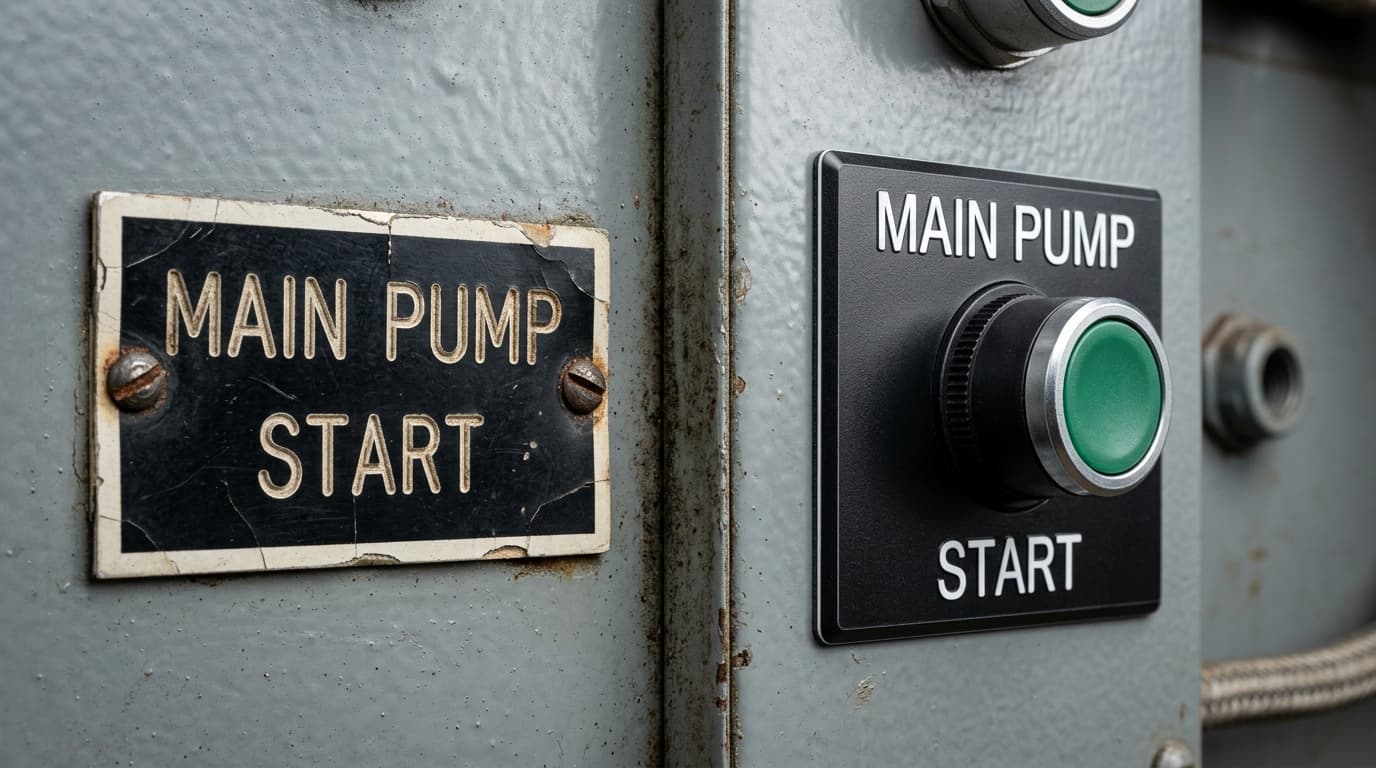
1. 3D Viscoelastic Foam Compression vs. Flat Viscoelastic Polymer Flow
The fundamental physical distinction governing control panel legend plates is structural thickness and mechanical energy dissipation. External cabinet doors require 3D dimensional prominence and compression over surface irregularities, whereas internal subpanels demand low-profile flush adhesion.
B-593: Compressible Closed-Cell Foam Core Architecture
B-483A: Ultra-Aggressive Viscoelastic Rubber Adhesive Flow
2. Substrate Peel Adhesion Matrix (ASTM D1000 180° Peel)
Standardized 180° peel adhesion testing across high surface energy (HSE), low surface energy (LSE), and textured powder-coated substrates after 20-minute and 24-hour dwell periods.
| Test Substrate | Surface Energy | B-593 Peel Force | B-483A Peel Force | Outcome |
|---|---|---|---|---|
| Stainless Steel (Smooth / Passivated) | >45 dynes/cm (High Energy) | 20-min: 189 oz/in (200 N/100mm) 24-hr: 289 oz/in (Foam Tear Failure) | 20-min: 155 oz/in (169 N/100mm) 24-hr: 160 oz/in (174 N/100mm) | B-593 (Massive bond; foam fractures before peel) |
| Polyester Powder-Coated Metal (Textured) | 28–36 dynes/cm (LSE + Texture) | 20-min: 41 oz/in (45 N/100mm) 24-hr: 69 oz/in (76 N/100mm) | 20-min: 102 oz/in (111 N/100mm) 24-hr: 104 oz/in (113 N/100mm) | B-483A (+50% higher ultimate peel on powder coat) |
| Smooth ABS Plastic (Pilot Light Bezels) | 38–42 dynes/cm (Medium Energy) | 20-min: 24 oz/in (26 N/100mm) 24-hr: 64 oz/in (70 N/100mm) | 20-min: 55 oz/in (60 N/100mm) 24-hr: 54 oz/in (59 N/100mm) | B-593 (+18% higher 24-hr bond on ABS) |
| Polypropylene & Polyethylene (LSE Plastics) | 29–31 dynes/cm (Low Energy) | 20-min: 28 oz/in (31 N/100mm) 24-hr: 37 oz/in (40 N/100mm) | 20-min: 140 oz/in (153 N/100mm) 24-hr: 143 oz/in (156 N/100mm) | B-483A (3.8x higher grip on olefin plastics) |
| ASTM D2979 Quick Probe Tack | Instant Initial Grab | 20-min: 16.5 oz (469 grams) 24-hr: 16.5 oz (469 grams) | 20-min: 39 oz (1,122 grams) 24-hr: 39 oz (1,122 grams) | B-483A (2.4x higher instant aggressive grab) |
3. Total Cost of Ownership (TCO) & Labor Economics: Outsourced Phenolic vs. Raised Panel vs. Flat Decals
Engraved phenolic plates represent one of the largest hidden labor and lead-time bottlenecks in control panel manufacturing. Switching to thermal-printed B-593 slashes costs by 85% while eliminating drilling labor.
| Economic Dimension | B-593 Raised Panel Plates (On-Demand) | B-483A Flat High-Tack Decals |
|---|---|---|
| Unit Material Purchase PriceReplaces $12.00 outsourced engraved phenolic plates. | $1.50 / legend plate (22.5mm cutout) | $0.14 / label (Flat rating decal) |
| Lead Time & Order TurnaroundOutsourced phenolic takes 3–7 business days + shipping. | 15 seconds (Print on-demand in shop) | 5 seconds (Print on-demand in shop) |
| Installation Labor & Tooling RequirementsPhenolic requires drilling 2 holes + riveting ($2.50 labor). | $0.42 (25s peel & stick under pushbutton) | $0.20 (12s manual peel & stick) |
| Total Installed Cost Per Push-Button PlateOutsourced engraved phenolic costs $14.50+ installed! | $1.92 / plate (Zero tooling) | $0.34 / decal (Flat, non-embossed) |
| Push-Button Bezel Torque ResistanceB-593's rigid face prevents operator switch rotation. | 100% Locked (Die-cut locator notch) | Prone to twisting/wrinkling under collar |
| Annual Cost Savings on 500-Plate Panel BuilderImmediate payback on Brady industrial printer hardware. | $6,290 saved vs outsourced phenolic | Best for internal subpanel serialization |
4. 15-Point Parametric Specification Diff
Direct ASTM laboratory metrics, operating limits, and physical mechanical properties extracted from verified Brady Technical Data Sheets (TDS).
| Technical Dimension | B-593 (Raised Panel Foam-Backed Legend Plates (0.025")) | B-483A (Flat Ultra-Aggressive High-Tack Polyester Decals) | Key Advantage |
|---|---|---|---|
| Physical Construction Caliper (Thickness) | 0.025" (25.0 mil / 0.65 mm) Raised Embossed Profile | 0.004" (4.0 mil / 0.102 mm) Low-Profile Flat Decal | B-593 (3D Engraved Look) vs B-483A (Flush Non-Snag Profile) |
| Substrate & Core Chemistry | Gloss Polyester Film + Closed-Cell Polyethylene Foam Carrier | 2.0 mil Gloss White Polyester Film (No Foam) | B-593 (Compressible Core) vs B-483A (High Tensile Film) |
| Adhesive Chemistry & Coat Weight | Permanent Acrylic Adhesive (Aggressive Initial Bond) | Ultra-Aggressive Permanent Rubber Adhesive (2.0 mil Coat) | B-593 (Foam Bond) vs B-483A (Extreme LSE Plastic Grip) |
| Color Options & Finishes | White, Black, Metallic Silver, Yellow, Red, Green | Gloss White (High Reflectance) | B-593 (6 Standard NEMA/IEC Industrial Panel Colors) |
| Push-Button Cutout Options | Pre-Die-Cut 22.5mm and 30.5mm Holes with Keyway Notches | Standard rectangular and square die-cut sizes | B-593 (Engineered specifically for pilot lights & E-stops) |
| Continuous Service Temperature Range | -20°C to +100°C (-4°F to +212°F) | -40°C to +120°C (-40°F to +248°F) | B-483A (+20°C higher high-temp / -40°C lower cold tolerance) |
| Outdoor Weatherability & UV Durability | 10-Year Outdoor Durability (ASTM G155 / B117) | Passed 30-Day Xenon Arc & 5% Salt Fog Chamber | B-593 (10-Year Rated for Outdoor Solar & NEMA 4X Panels) |
| Peel Adhesion on Stainless Steel (24-hr) | 289 oz/in (Foam Carrier Tear Failure) | 160 oz/in (174 N/100mm) (ASTM D1000) | B-593 (Massive bond exceeds internal foam shear strength) |
| Peel Adhesion on Powder-Coated Metal | 69 oz/in (76 N/100mm) (Foam Conforms to Dimples) | 104 oz/in (113 N/100mm) (Rubber Flows into Texture) | B-483A (+50% higher direct peel on textured powder paint) |
| Peel Adhesion on Polypropylene (LSE) | 37 oz/in (40 N/100mm) (ASTM D1000) | 143 oz/in (156 N/100mm) (ASTM D1000) | B-483A (3.8x higher grip on non-polar polyolefins) |
| Drop Shear Hold Time (ASTM D1000) | 35.0+ Hours Static Shear Hold | High Shear Resistance (Rubber Polymer) | B-593 (Specifically rated for heavy vertical door vibration) |
| UL 969 Marking Recognition | UL Recognized (File MH17154) with R6000HF & R4400-WT | UL Recognized (File MH17154) with R6000HF & R4900 | Tie (Both UL 969 Recognized under File MH17154) |
| CSA Acceptance (C22.2 No. 0.15) | CSA Accepted (File 041833) | CSA Accepted (File 041833) with Series R6000HF ribbon | Tie (Both CSA Accepted for Canadian Electrical Code) |
| Engraved Phenolic Plate Replacement | Direct drop-in replacement (0.025" embossed profile) | Flat decal (Does not replicate 3D engraved look) | B-593 (Matches aesthetics of traditional $12 phenolic plates) |
| Printer Feed Path Requirement | Straight-through flat feed path (i3300, i5300, i7100, BMP71) | Standard curved or straight feed roll path (All printers) | B-483A (Compatible with compact portable printers like M410) |
5. Chemical Immersion & Harsh Solvent Head-to-Head
Standardized 5-cycle immersion testing (10-minute fluid exposure + 30-minute recovery period per ASTM protocols followed by cotton swab rub tests).
| Chemical Reagent | B-593 Observation | B-483A Observation | Outcome |
|---|---|---|---|
| Methyl Ethyl Ketone (MEK) | No visible effect on face w/o rub; print removed on rub | Slight adhesive ooze; print removed on rub | Tie |
| Isopropyl Alcohol (IPA 99%) | Passed (No visible effect on plate face, foam, or print) | Passed (No visible effect on label or print) | Tie |
| Mineral Spirits & Aliphatics | Passed (No visible effect on plate face or adhesive) | Slight adhesive ooze; print intact | B-593 |
| Gasoline & Automotive Fuel | Passed (No visible effect on plate face or print) | Passed (No visible effect on label or print) | Tie |
| SAE 20 WT Engine Oil & Lubricants | Passed (1000 hrs immersion: zero degradation) | Passed (No visible effect on substrate or print) | Tie |
| MIL-H-5606 Hydraulic Fluid | Passed (No visible effect on face; slight foam edge stain) | Passed (Slight adhesive ooze; print intact) | Tie |
| 10% Sulfuric Acid Solution | Passed (Zero effect on polyester surface or foam) | Passed (Zero effect on substrate or print) | Tie |
| 10% Sodium Hydroxide Solution | Passed (Zero effect on polyester surface or foam) | Passed (Zero effect on substrate or print) | Tie |
| 3% Alconox® Detergent & Cleaners | Passed (1000 hrs no effect) | Passed (1000 hrs no effect) | Tie |
| Northwoods Buzz Saw Citrus Degreaser | Passed (No visible effect on plate face or print) | Passed (No visible effect on label or print) | Tie |
| Deionized Water & Moisture Washdown | Passed (1000 hrs 100°F 95% R.H.: zero effect) | Passed (1000 hrs 100°F 95% R.H.: zero effect) | Tie |
| Salt Fog Chamber (ASTM B117 / 1000 hrs) | Passed (1000 hrs 5% salt spray: zero corrosion) | Passed (30 days 5% salt fog: zero degradation) | B-593 |
6. Failure Modes: When to NEVER Use B-593 vs. B-483A
Critical engineering boundary limits where material physics fail under extreme environmental, mechanical, or chemical stress.
- Tight Curved Surfaces or Small-Diameter Wires (<1.0" radius): The 0.025" thick rigid foam construction cannot bend around curved conductors or tight pipes without severe delamination.
- Internal High-Density Subpanel Component Tagging: Thick foam legend plates are bulky and cost $1.50 each—unnecessarily expensive for terminal strips, PLC cards, and internal relays.
- Continuous Immersion in Harsh Ketones (MEK/Acetone): Solvent immersion will wick into exposed foam edges over prolonged submersion (use flat chemical-resistant polyester B-423 or polyimide B-724).
- Printers with Tight Curved Roll Feed Paths: Standard compact mobile printers cannot feed 0.025" thick rigid foam through tight rollers (must use straight-feed printers like i3300, i5300, i7100, or BMP71/M710).
- External NEMA Cabinet Push-Buttons Where Engraved Look is Specified: Flat 0.004" decals look cheap and thin compared to traditional engraved phenolic plates, failing customer aesthetic specs.
- Emergency Stop Background Legend Rings: Flat decals lack the heavy-duty dimensional presence and anti-rotation locator notches required for yellow E-stop rings.
- Coarse Rough Cast Metal or Uneven Surfaces: Thin 0.004" decals telegraph underlying weld spatter, screw heads, and rough surface defects (B-593's foam core absorbs surface irregularities).
- Applications Requiring Metallic Silver or Colored Engraved Nameplates: B-483A is only available in gloss white, whereas B-593 offers Silver, Black, Red, Yellow, and Green.
7. Hardware Intelligence: Thermal Transfer Ribbon Formulation & Printers
A high-performance rating plate or wire marker is only as durable as the thermal transfer ribbon chemistry paired with it.
Engineering Decision FAQ: B-593 vs. B-483A
Traditional engraved phenolic nameplates require outsourcing to an engraving shop ($10–$15 per plate with 3–7 day lead times) or maintaining an expensive CNC rotary engraving machine in-house. Once engraved, phenolic plates require drilling mounting holes in the control cabinet door and securing with screws or rivets ($2.50+ in labor). B-593 Raised Panel material features a 0.025" (25 mil) thick compressible foam backing with a high-gloss polyester surface that replicates the exact 3D embossed look and feel of engraved plastic. Panel builders can print custom legends on-demand in 15 seconds on a Brady i3300 or BMP71/M710 printer and peel-and-stick them directly onto the cabinet door, reducing total installed cost from $14.50+ down to $1.92 per plate (an 85%+ savings).
Push-buttons, emergency stop mushroom caps, and selector switches undergo continuous physical twisting and torque from machine operators. B-593 legend plates are die-cut with exact 22.5mm or 30.5mm center holes and anti-rotation keyway locator notches. When the push-button collar is tightened down, the 0.025" compressible foam absorbs the mechanical clamping pressure and prevents the switch from rotating or loosening over years of operation. In contrast, flat 0.004" decals (B-483A) have no structural thickness, making them prone to wrinkling, twisting, or bunching under operator torque.
Because B-593 is 0.025" (25 mil / 0.65 mm) thick, it requires a printer with a straight-through flat media feed path to prevent foam bending or printhead jamming. Compatible industrial benchtop printers include the Brady i3300, i5300, i7100, BBP12, and PR Plus. For portable field printing, the Brady BMP71 and M710 support B-593 rolls. Smaller handheld printers (like the M210, M410, and BMP21) have tight curved roll feed paths that cannot accommodate thick raised panel stock.
For Black, Red, or dark-colored B-593 plates, you must print with Brady Series R4400-WT White thermal transfer resin ribbon to achieve brilliant, high-opacity white text that matches traditional white-core engraved phenolic. For White, Metallic Silver, Yellow, and Green B-593 plates, print with Brady Series R6000 Halogen Free (R6000HF) black pure resin ribbon. Both ribbon series are UL 969 Recognized and CSA Accepted under File MH17154 / 041833.
Yes! B-593 is rated for 10-year outdoor durability. In standardized testing, B-593 undergoes 1,000 hours of continuous 100°C heat, 1,000 hours of 5% Salt Spray Chamber exposure (ASTM B117), and 1,000 hours of humidity testing with zero visible effect or adhesive degradation. It is fully weatherproof, UV resistant, and impervious to rain, ice, and salt spray.
Choose flat B-483A decals for internal subpanel component marking (relays, contactors, terminal blocks, DIN rail power supplies, PLC racks) and high-density serial rating decals. Inside crowded electrical enclosures, B-593's 0.025" thickness is unnecessarily bulky and costs 10x more per piece ($1.50 vs $0.14). B-483A's ultra-low 0.004" profile sits completely flush, cannot snag wiring bundles, and features a 2.0 mil heavy rubber adhesive that grips textured subpanels and LSE plastics.
No. B-593 is coated with an ultra-aggressive permanent acrylic adhesive rated at 289 oz/in peel adhesion on stainless steel. Attempting to pry off a B-593 plate will result in foam carrier fracture (the foam core splits in half, leaving the adhesive layer permanently bonded to the paint). If an equipment legend or circuit function changes, the best practice is to simply apply a new B-593 plate directly over the existing plate or clean the surface with an adhesive remover solvent.