Resistance to Solvents for Electronic & Electrical Components (MIL-STD-202G / Method 215K)
Establishes standardized military testing procedures to verify that markings on printed circuit boards, electronic chassis, semiconductor packages, connectors, and wire sleeves survive aggressive industrial solvents, defluxers, and saponifier washdowns used during PCB assembly. This engineering compliance guide details the mandated laboratory test procedures, authorized thermal transfer ribbons, and officially recognized Brady material combinations.
Specimens are subjected to 3 distinct chemical solvent groups: Group 1 (1 part Isopropyl Alcohol + 3 parts Mineral Spirits @ 25°C), Group 2 (Terpene defluxer / d-limonene solvent blend @ 25°C), and Group 3 (Aqueous saponifier consisting of 42 parts deionized water, 1 part propylene glycol monomethyl ether, and 1 part monoethanolamine heated to 63°C–70°C / 145°F–158°F). Samples are immersed for 3 minutes per group, immediately followed by 10 manual strokes with a mechanical nylon bristle toothbrush under a calibrated 2.0-ounce (0.56 N) force. Zero character degradation is permitted.
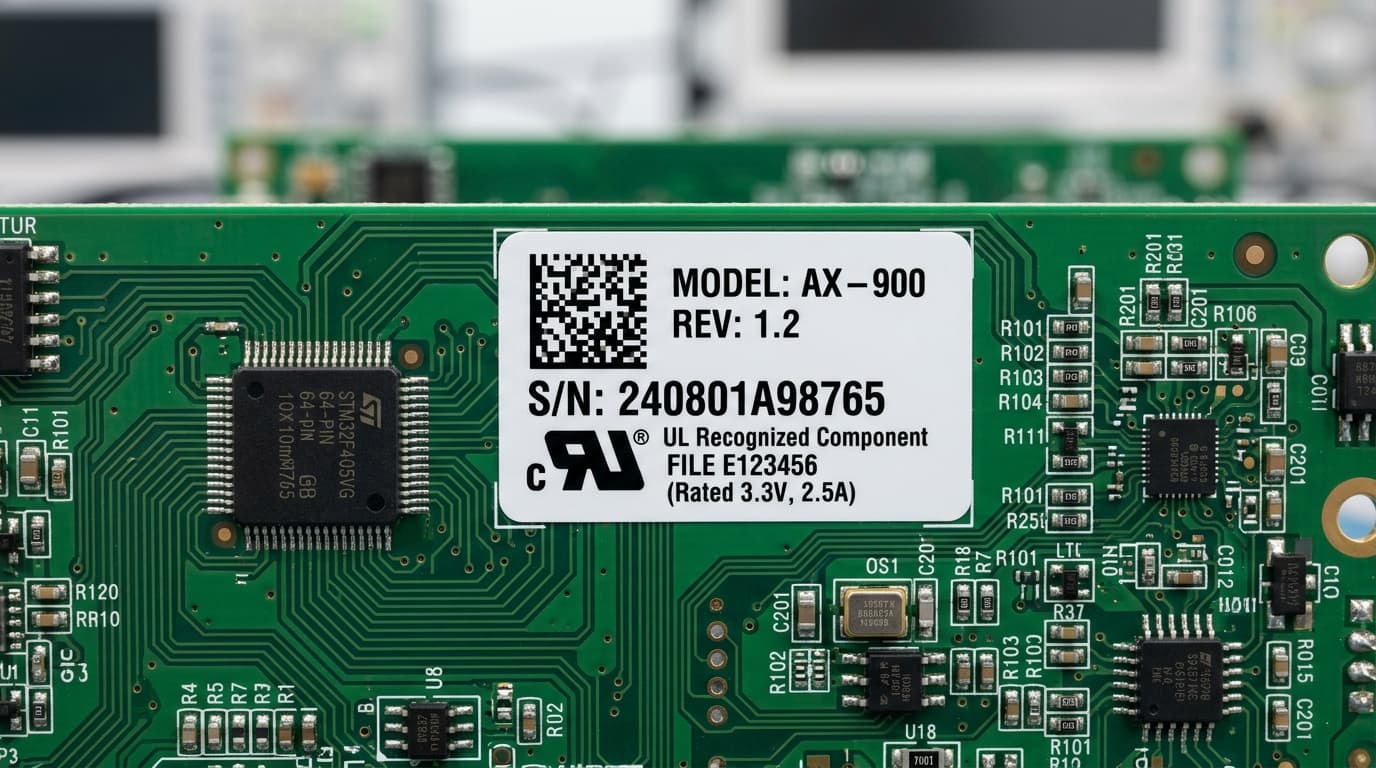
Certified Brady B-Number Materials for MIL-STD-202G / Method 215K
High-Temperature Polyimide PCB Tracking Film (300°C)
Passes Method 215K solvent immersion and mechanical brushing with zero character degradation after 300°C wave solder reflow.
Ultra-Thin Auto-Feeder Matte Polyimide (330°C)
Fully certified through hot aqueous saponifier washdowns (Kyzen Aquanox® / Zestron® Vigon) under Method 215K.
PermaSleeve® 3:1 Polyolefin Wire Markers
Passes all three solvent test groups with zero ink bleed or polyolefin sleeve swelling.
Permanent Gloss White Polyester Rating Decals
Resists Method 215K solvent wiping for defense chassis and electronic power supply rating plates.
Certified Orderable SKUs for MIL-STD-202G / Method 215K
Catalog part numbers, Grainger SKUs, roll dimensions, and list pricing.
Compliance & Quality Audit FAQs: MIL-STD-202G / Method 215K
Agency certifications (UL 969, SAE-AS-81531, MIL-STD-202G) evaluate the complete printed system—the face stock, the adhesive, and the ink formulation. If an unapproved third-party ribbon is used, the print may fail solvent or eraser abrasion testing, voiding the certification and failing AS9100 / ISO audits.
Click through to any material profile page (e.g. B-342 or B-7642) and use the "Print Spec Sheet" button in the top right to generate a clean, PDF-ready engineering submittal package.